
Religious Studies
KS3
KS4
KS5 (SIXTH FORM)
Summary
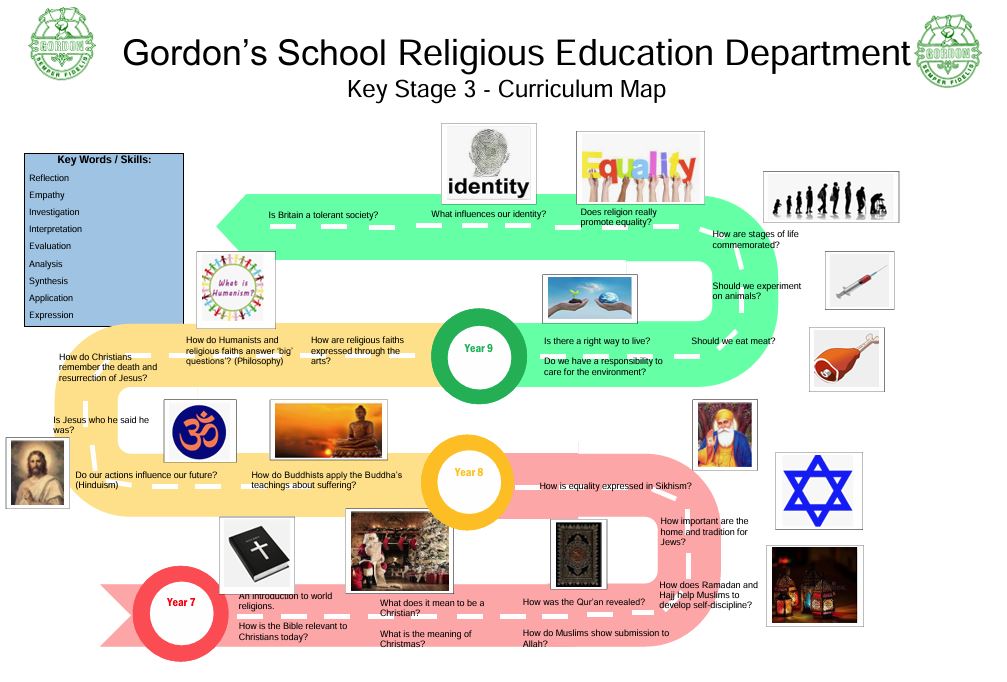
At Key Stage 3, the beliefs and practices of the major world religions, philosophical questions and ethical issues are studied. Students will have the opportunity to learn about religious and non-religious responses, as well as to explore their own, to questions about identity, belonging, meaning, purpose, truth, values and commitments.
At Key Stage 3, topics will include comparing and contrasting worship within and between religions; the Buddhist response to suffering; whether Jesus was who he said he was; and, if animal testing is morally right.
Head of Department: Mrs Lewis flewis@gordons.school
Summary
At GCSE, students follow the AQA Religious Studies A syllabus.
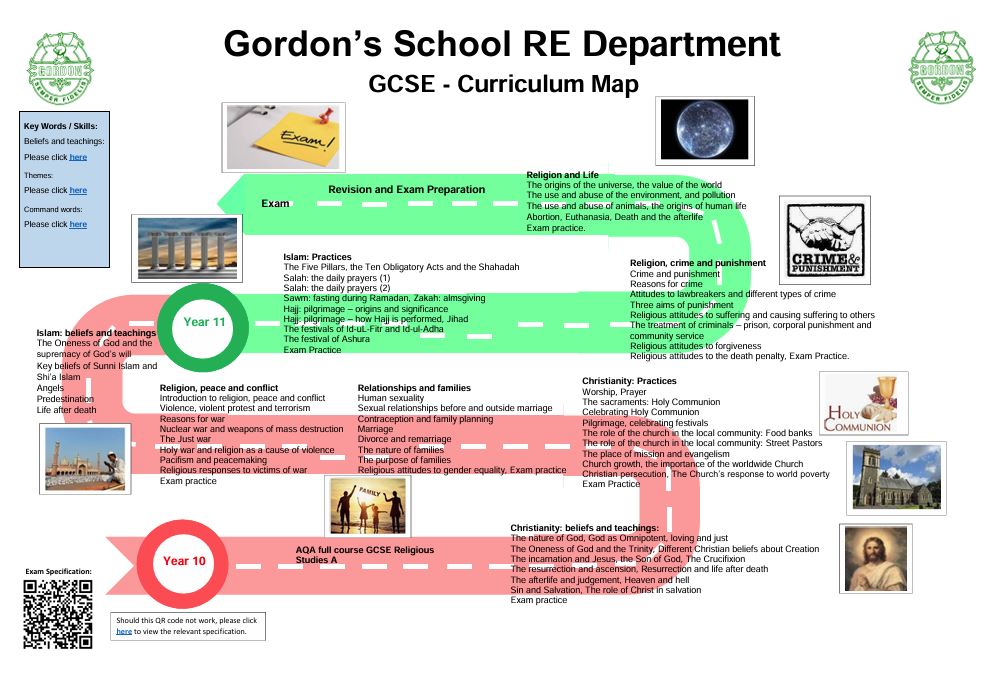
Students study the beliefs and practices of two world religions and their responses to ethical issues and philosophical questions. Students consider contrasting beliefs from religious and secular perspectives within the context of contemporary British society.
Religious Studies at GCSE lays a good foundation for further study of Religious Studies at A Level and complements other related A Level subjects including Philosophy, Law, History, History of Art, Government and Politics, Sociology and English Literature.
Course details
At GCSE students study:
The beliefs, teachings and practices of Christianity, Islam + Four religious, philosophical and ethical studies from:
Theme A: Relationships and families
Theme B: Religion and life
Theme C: The existence of God and revelation
Theme D: Religion, peace and conflict
Theme E: Religion, crime and punishment
Theme F: Religion, human rights and social justice
Click here to see further detail from AQA's website
GCSE Full course
For the full course GCSE students study:
The beliefs, teachings and practices of Christianity, Buddhism + Four religious, philosophical and ethical studies from:
Theme A: Relationships and families
Theme B: Religion and life
Theme C: The existence of God and revelation
Theme D: Religion, peace and conflict
Theme E: Religion, crime and punishment
Theme F: Religion, human rights and social justice
Click here to see further detail from AQA's website
TYPICAL ACTIVITIES
- Discussion and debate of contemporary moral issues. For example, should animals be tested on? Should the legal limit for abortion be lowered? Is enough being done to tackle racism in football? Considering the ‘Big Questions’ like ‘Does God exist? Is there life after death? Why is there suffering and evil?
- Interpreting religious teachings and applying them to modern day scenarios. For example, how does a belief in stewardship influence decisions about how we treat the environment?
- Formulating and expressing opinions. Exploring our own views, and those of others, to engage in the issues and questions that religion raises. To be able to vocalise and write down those views, from a religious or non-religious perspective.
summary
Whilst we do not offer a full A level in Religious Studies, students can study AS level Religious Studies as a +1 subject in Year 12.
This is an examined course and comprises three components: Philosophy of Religion; Religion and Ethics; and Developments in Christian Thought.
Each component is examined at the end of Year 12, and grades are awarded equivalent to A level.
COURSE DETAILS
Please use the link to the OCR website for the full content of each component.
Philosophy of Religion:
- Ancient philosophical influences
- Soul, mind and body
- Arguments based on observation
- Arguments based on reason
- Religious experience
- The Problem of Evil
Ethics:
- Natural Law
- Situation Ethics
- Kantian Ethics
- Utilitarianism
- Euthanasia
- Business Ethics
Developments in Christian Thought:
- Augustine’s teaching on human nature
- Death and the afterlife
- Knowledge of God’s existence
- The person of Jesus Christ
- Christian moral principles
- Christian moral action